

Injectable Collagen vs Collagen Biostimulators

Injectable Collagen vs Collagen Biostimulators at a Glance
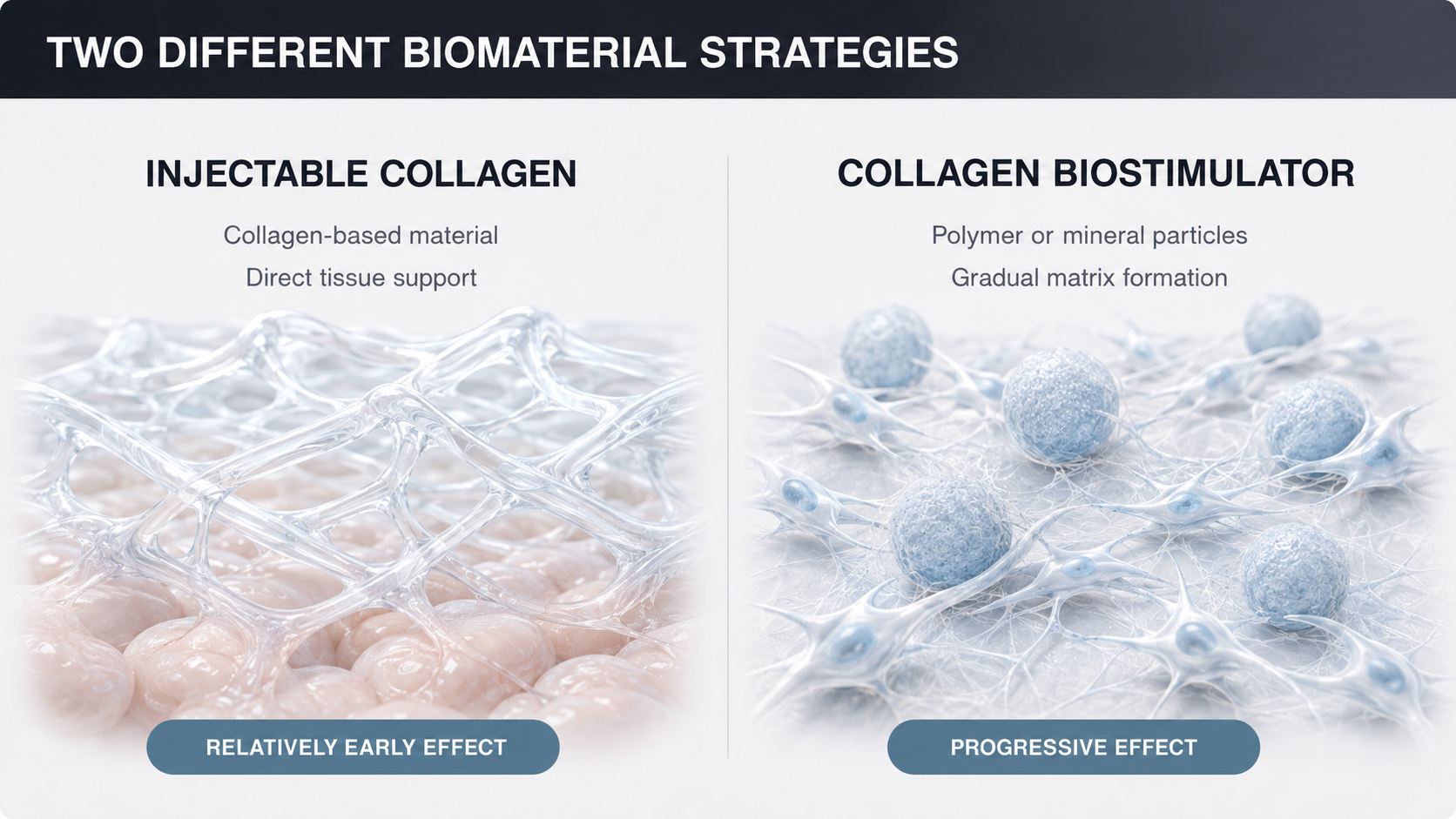
| Characteristic | Injectable Collagen | Collagen Biostimulator |
|---|---|---|
| What is injected? | Collagen or collagen-derived material | Biodegradable polymer or mineral particles |
| Common materials | Animal-derived, human-derived, or recombinant collagen | PLLA, PDLLA, PCL, or CaHA |
| Main mechanism | Direct collagen-based tissue support | Gradual stimulation of new extracellular matrix |
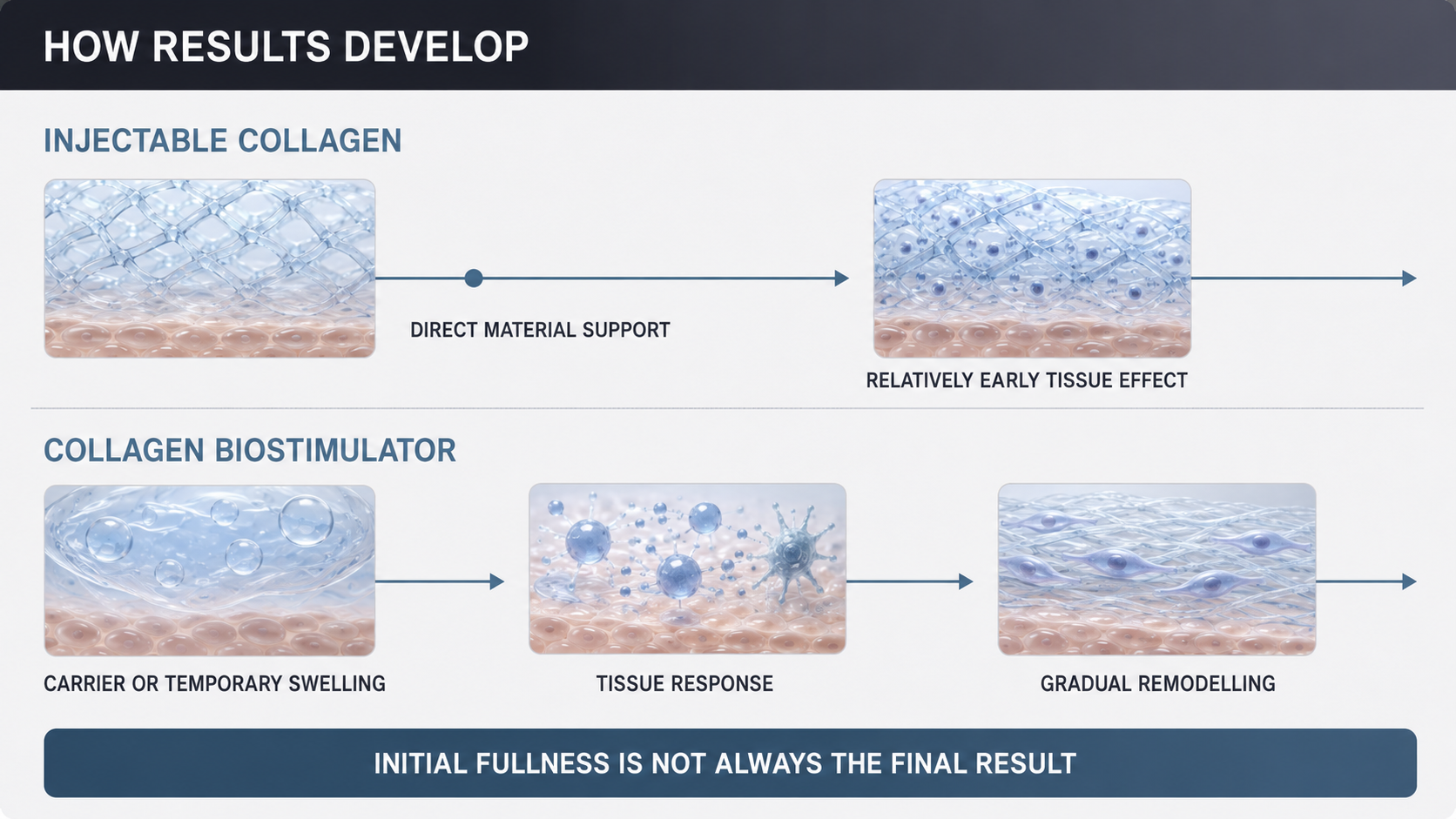
| Development of results | May provide a relatively early tissue effect | Usually develops progressively |
| Volume effect | Depends on the formulation | Depends on material, carrier, and treatment method |
| Examples | Lapiena RH-X Collagen, Collaju, Richesse Collafilo | Olidia, Juvelook, Gouri, Etrebelle PCL, Volassom |
What Is Injectable Collagen?
Collagen is the principal structural protein of the skin. It forms fibres that help provide tensile strength, firmness, and support to the extracellular matrix.
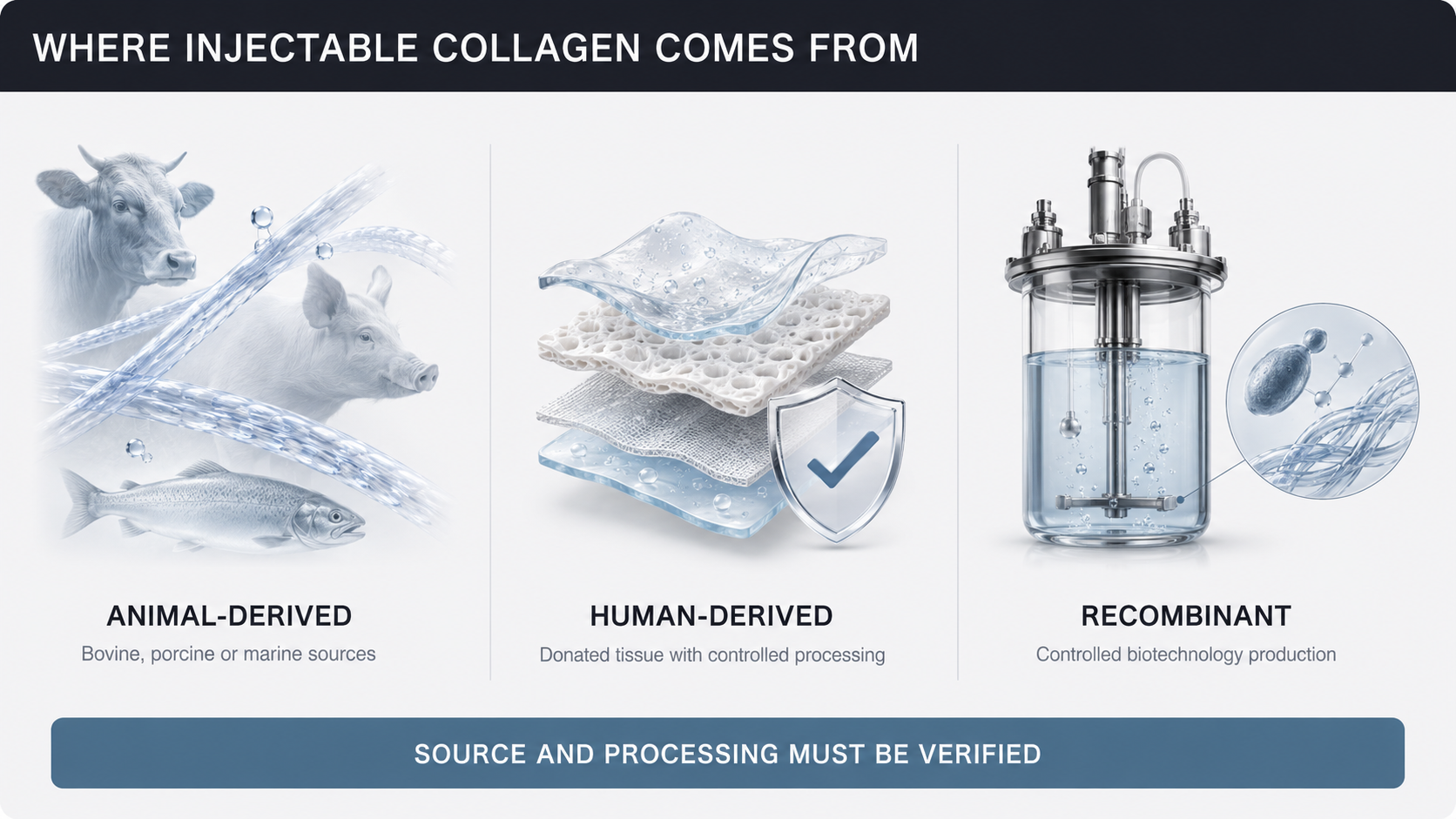
An injectable collagen product contains collagen itself or a collagen-related biomaterial. Depending on the product, the collagen may be obtained from animal tissue, donated human tissue, or recombinant biotechnology.
Injectable collagen is not one standardized product category. Two products may differ significantly in biological source, collagen type, concentration, molecular structure, degree of cross-linking, purification, and additional ingredients.
Where Does Injectable Collagen Come From?
Animal-Derived Collagen
Traditional injectable collagen was commonly obtained from bovine or porcine tissue. Marine collagen may also be used in some medical and cosmetic materials.
During manufacturing, collagen is extracted and purified to remove cells, lipids, unwanted proteins, and other biological components. The finished ingredient is therefore a processed collagen fraction rather than untreated animal tissue.
Some products use atelocollagen, in which terminal telopeptide regions have been removed. Because these regions contain important antigenic sites, their removal may reduce—but does not completely eliminate—the risk of an immune reaction.
Product quality depends on the source tissue, purification, residual protein levels, cross-linking, sterility, endotoxin control, and manufacturing standards.
Human-Derived Collagen
Some collagen biomaterials are produced from donated human tissue. The material undergoes donor screening, decellularization, purification, and sterilization to remove cells and reduce immunological and infectious risks while preserving selected collagen or extracellular-matrix components.
Human tissue-derived products require particularly careful donor traceability, regulatory control, and documentation. Their legal classification and availability vary between countries.
Recombinant Human Collagen
Recombinant human collagen is produced through biotechnology rather than extracted directly from animal or human tissue.
A genetic sequence encoding a human collagen protein is introduced into a controlled biological production system. Depending on the technology, yeast, bacteria, plant cells, or other host organisms may produce the collagen-related protein. The material is subsequently isolated and purified.
Recombinant production may provide greater batch consistency and avoid many contaminants associated with animal tissue. However, the term “recombinant human collagen” does not automatically mean that the finished material is completely identical to mature collagen in human skin. Its molecular size, folding, chain assembly, purity, stability, and biological behaviour depend on the production platform and final formulation.
Lapiena RH-X Collagen
According to the manufacturer’s product information, this formulation contains recombinant human collagen types I and III together with hyaluronic acid and additional skin-conditioning components. Because it is a multi-ingredient formulation, its effects cannot be attributed to collagen alone. The current product label and official instructions should be checked for exact composition, concentrations, route, and storage requirements.
Other Collagen Products at Derma Solution
The Derma Solution Collagen category also includes Collaju and Richesse Collafilo. These products are positioned as collagen-containing fillers.
A product should not automatically be described as bovine, porcine, marine, human-derived, atelocollagen, or recombinant collagen unless the biological source and processing method are explicitly confirmed by the manufacturer. Professionals should verify the collagen source, concentration, purification, additional ingredients, registration, and official instructions.
What Is a Collagen Biostimulator?
A collagen biostimulator does not primarily deliver finished collagen. It usually contains biodegradable particles or another biomaterial suspended in a carrier.
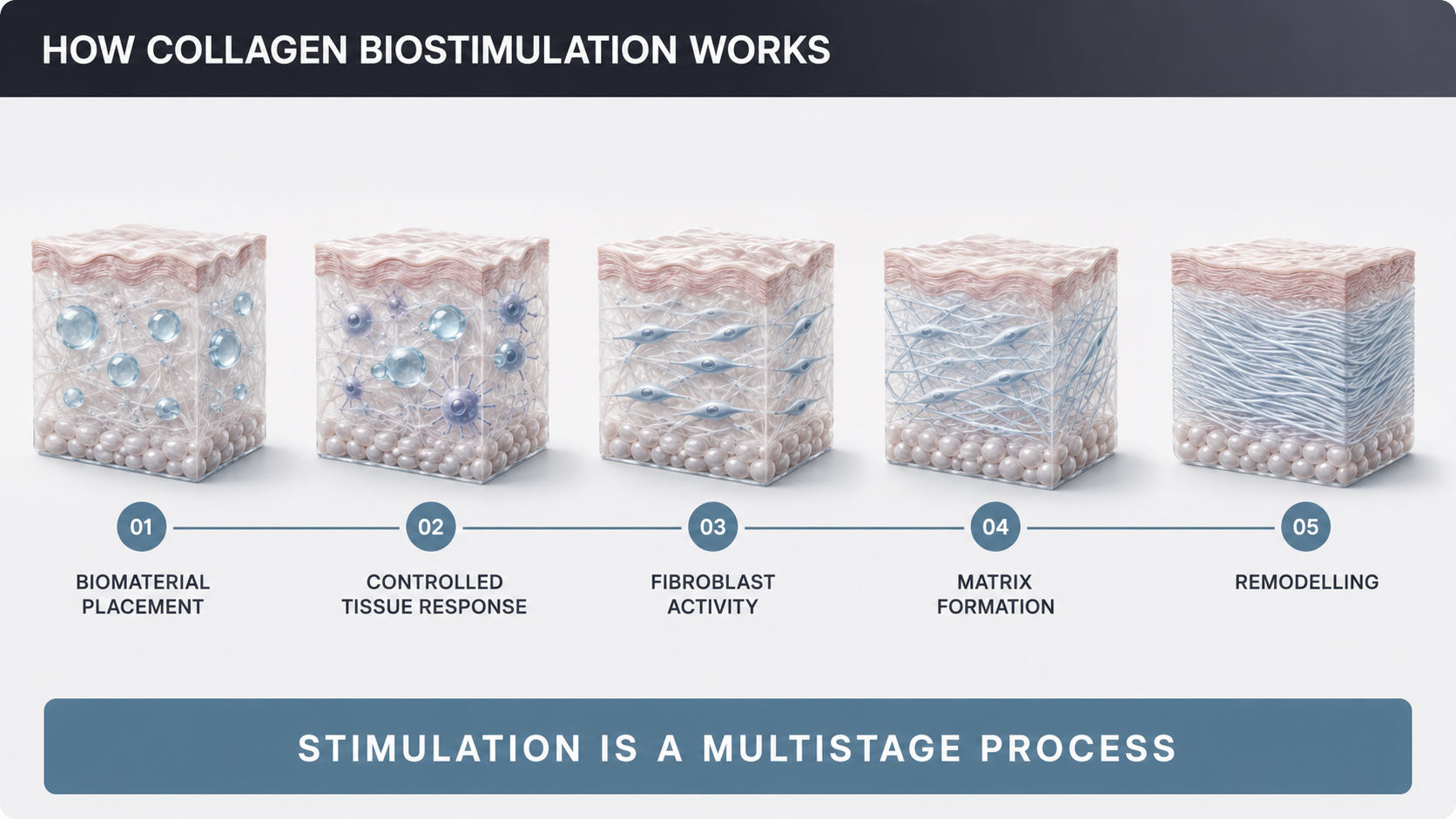
After administration, the material interacts with surrounding tissue. This produces a controlled response involving macrophages, fibroblasts, cellular signalling, extracellular-matrix deposition, and gradual tissue remodelling.
The word “stimulation” should not be interpreted as simple or immediate collagen production. The response involves several stages, including inflammation, material degradation, fibroblast activity, matrix formation, and remodelling.
Poly-L-Lactic Acid: PLLA
Poly-L-lactic acid is a biodegradable synthetic polymer. It does not contain collagen.
After administration, PLLA particles produce a controlled tissue response involving macrophages and fibroblasts. The carrier fluid is gradually absorbed, while the characteristic effect develops over time as new extracellular matrix forms around the particles.
An early change in fullness may reflect the volume of the carrier or temporary swelling. This should not be confused with the final result of tissue remodelling.
PLLA products: Olidia, POWER COL-TRA, Petaran Poly PLLA, PiNkLLA, PowerFill, and AestheFill
Olidia and POWER COL-TRA are listed as PLLA-based products supplied in 365 mg vials. Products within this category should not be treated as interchangeable: particle morphology, molecular weight, concentration, carrier, reconstitution requirements, authorized indications, and clinical evidence may differ.
Poly-D,L-Lactic Acid: PDLLA
Poly-D,L-lactic acid contains both D- and L-forms of lactic-acid polymer. This gives PDLLA a more amorphous structure than PLLA and affects how the material behaves and degrades.
Like PLLA, PDLLA does not contain finished collagen. Its particles act as temporary biomaterial structures that induce a gradual tissue response and extracellular-matrix formation.
Some PDLLA products are combined with hyaluronic acid. In these hybrid formulations, HA may contribute hydration or an earlier physical effect, while PDLLA is intended to support longer-term tissue remodelling.
PDLLA products: Juvelook 50 mg, Juvelook i 30 mg, and Juvelook Volume 200 mg
Juvelook products combine PDLLA with hyaluronic acid but differ in concentration and intended clinical emphasis. Juvelook 50 mg is positioned for progressive skin-quality improvement, while Juvelook Volume contains a higher amount of PDLLA. A protocol used for one version should not automatically be applied to another.
Polycaprolactone: PCL
Polycaprolactone is a biodegradable synthetic polyester used in various medical biomaterials. PCL is not collagen. It functions as a temporary biomaterial that interacts with surrounding tissue while gradually degrading.
The clinical behaviour of a PCL product depends on its polymer structure, concentration, carrier, viscosity, degradation profile, and tissue placement. A liquid PCL formulation should not automatically be considered equivalent to a traditional particulate PCL filler.
PCL products: Gouri, PCL Power Booster, and Etrebelle PCL 200 mg
Gouri is a liquid PCL-based product supplied in a 1 mL prefilled syringe. Etrebelle PCL 200 mg is a hybrid containing 100 mg of PCL and 100 mg of hyaluronic acid. Its earlier physical effect therefore cannot be attributed to PCL alone; the HA component may contribute hydration and filling.
Calcium Hydroxyapatite: CaHA
Calcium hydroxyapatite is a mineral related to the inorganic component naturally found in bone and teeth. Injectable CaHA products generally contain synthetic CaHA microspheres suspended in a gel carrier.
The gel may provide an initial physical effect, while the microspheres act as a temporary scaffold around which collagen and other matrix components can develop. CaHA differs from PLLA, PDLLA, and PCL because it is a mineral biomaterial rather than a biodegradable synthetic polymer.
Volassom
Volassom is listed as a CaHA product containing calcium hydroxyapatite microspheres suspended in a gel carrier and supplied in two 0.8 mL prefilled syringes. The carrier may contribute an earlier lifting or volumizing effect, while the CaHA microspheres are intended to provide longer-term tissue support.
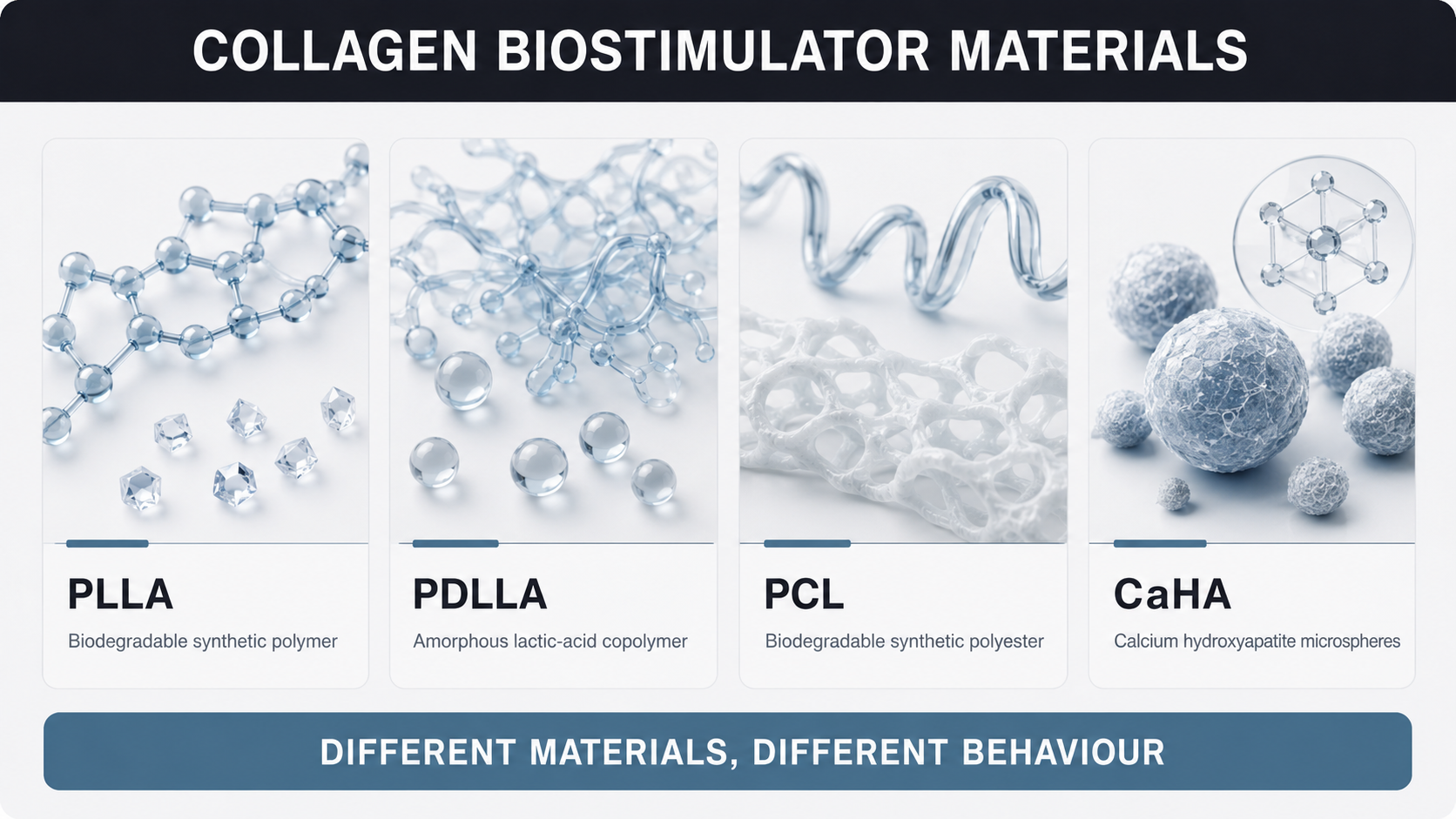
Comparison of Products Available from Derma Solution
| Material | What It Contains | Main Mechanism | Examples |
|---|---|---|---|
| Recombinant collagen | Biosynthesized collagen-related protein | Direct collagen-based support | Lapiena RH-X Collagen |
| Other collagen fillers | Collagen or collagen-derived material | Direct material support | Collaju; Richesse Collafilo |
| PLLA | Biodegradable synthetic polymer | Progressive matrix formation | Olidia; POWER COL-TRA; others |
| PDLLA | Amorphous lactic-acid copolymer | Gradual tissue remodelling | Juvelook range |
| PCL | Biodegradable synthetic polyester | Temporary biomaterial support | Gouri; PCL Power Booster; Etrebelle PCL |
| CaHA | Calcium hydroxyapatite microspheres | Scaffold effect and remodelling | Volassom |
How Do the Results Differ?
Injectable collagen provides a collagen-containing material directly. Depending on its physical properties, it may offer temporary matrix support, improve hydration, or produce a relatively early change in skin texture and firmness.
A collagen biostimulator relies more heavily on the patient’s biological response. Initial fullness may be caused partly by the carrier, injected volume, or temporary swelling. The more characteristic effect develops gradually as the tissue responds to the material.
Injectable collagen is therefore not simply a faster version of a biostimulator, and a biostimulator is not collagen in another form. They represent different biomaterial strategies.
Which Produces More Volume?
Neither category has one universal volumizing effect. Some injectable collagen products are designed mainly for superficial skin-quality improvement and provide little structural volume. Other collagen formulations may behave more like soft-tissue fillers.
Biostimulators also differ. Their volume effect depends on the material, particle properties, carrier, concentration, dilution, treatment depth, and total amount administered. Hybrid products containing a biostimulatory material and HA may provide an earlier physical effect together with gradual tissue remodelling.
For significant volume loss or precise contour correction, a conventional dermal filler may still be more appropriate.
Are Injectable Collagen and Biostimulators Interchangeable?
No. They may address overlapping concerns, but their materials and mechanisms differ.
Injectable collagen may be considered when the intended product function is direct collagen-based tissue support or skin conditioning. A biostimulator may be considered when the objective is progressive endogenous matrix formation.
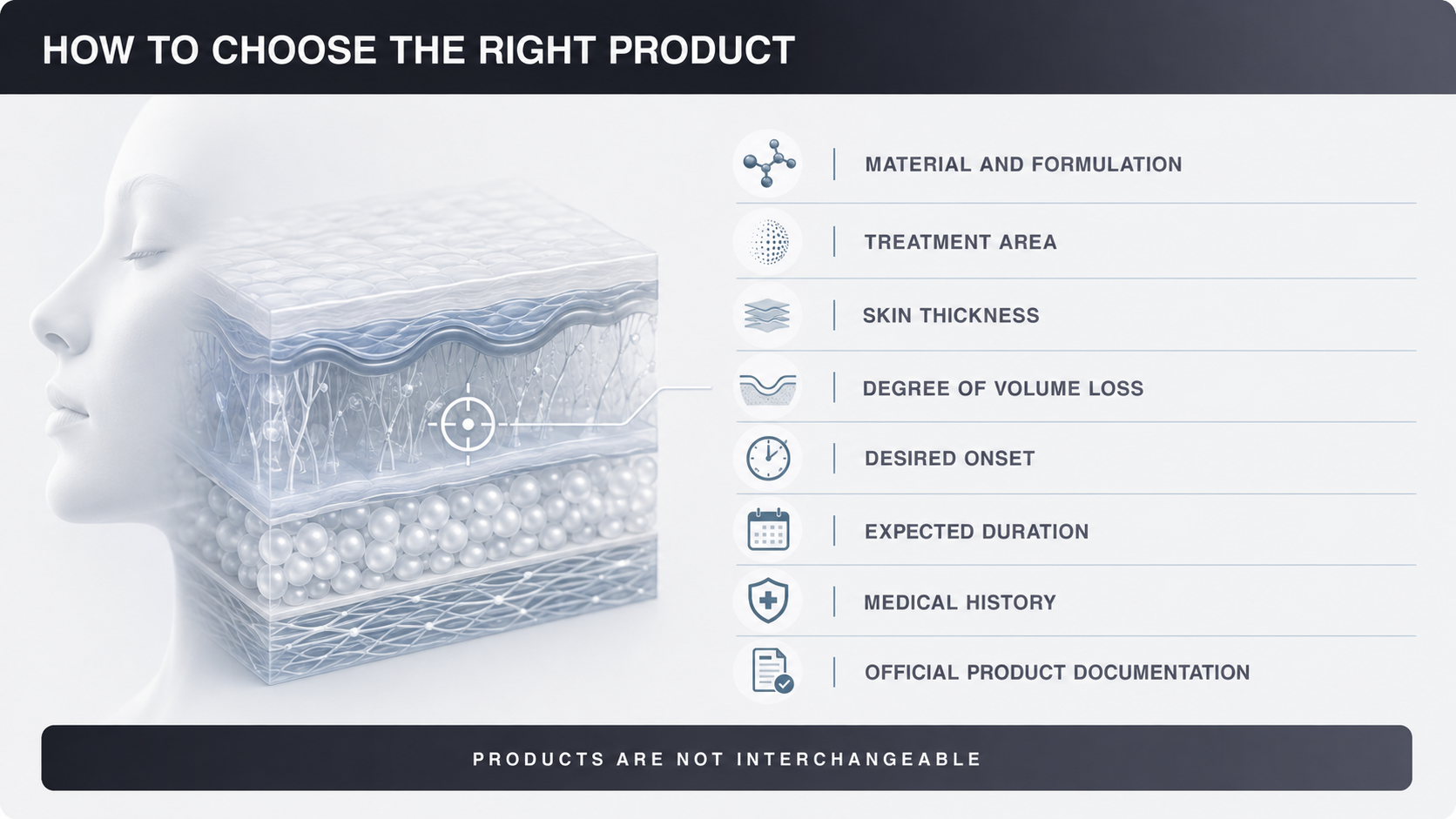
The correct choice depends on skin thickness, treatment area, degree of volume loss, medical history, desired onset, expected duration, and the properties of the exact product. Products should not be physically mixed in the same syringe unless the combination is explicitly supported by the manufacturer.
Final Thoughts
Injectable collagen and collagen biostimulators are not the same treatment category.
Injectable collagen introduces collagen or a collagen-derived material directly into the tissue. Collagen biostimulators use biodegradable polymers or mineral particles to induce a gradual tissue response and stimulate the formation of the patient’s own extracellular matrix.
Recombinant collagen products such as Lapiena RH-X Collagen represent direct collagen-based technology. PLLA products such as Olidia and POWER COL-TRA, PDLLA products such as Juvelook, PCL products such as Gouri and Etrebelle PCL, and CaHA products such as Volassom use different biostimulatory materials.
Their effects may overlap, but their composition, mechanism, onset, duration, and risks differ. Product selection should therefore be based on the complete formulation, official documentation, patient assessment, and treatment objective—not simply on the promise of “more collagen.”